
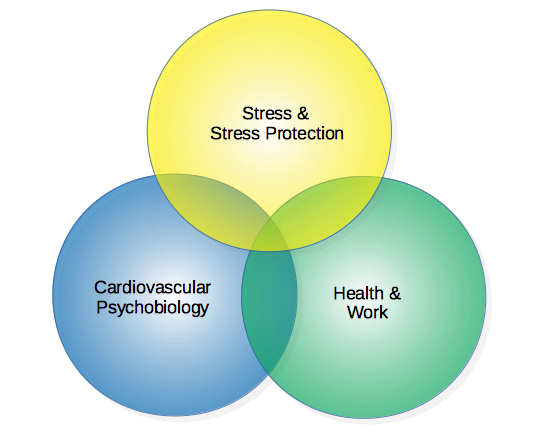
Stress and stress protection
Stress is a common phenomenon that has both psychological and physical effects on many people. Psychosocial (work) stress, for instance, is an independent risk factor for somatic diseases such as cardiovascular disease, which have topped the list of most common causes of death in industrial nations for years. Exposure to stress can also cause considerable cost to the public health system.
When the connection between stress and the risk of falling ill is considered, the physiological response to stress seems to play a decisive role. In our research, we use standardised tests to provoke psychosocial stress and to examine the kinetics and mechanisms of stress reactivity in physiological parameters from blood and saliva. The examined physiological systems include human stress systems such as the sympathoadrenomedullary system (SAM) and the hypothalamus-pituitary-adrenal axis (HPA), but also the immune and coagulation systems as well as other stress-reactive intermediary-biological risk factors for cardiovascular disease. Our current work focuses on intracellular stress responses that are then expanded to include age-relevant parameters. We are particularly interested in the correlatives and determinants of physiological stress reactivity. We identified the cognitive evaluation of the stressor as a psychological determinant; psychological correlatives include, amongst others, personality traits such as the excessive willingness to exert energy (overcommitment) or perfectionism, but also relative factors such as role stress. As regards stress protection, we investigate the stress-protective effects of selected psychological and other interventions in addition to the correlation between potential protective factors (e.g. social support, stress management skills, advantageous emotional regulation, sports activities) and reduced physiological stress reactivity. Previously effective interventions include stress management training, taiji practice or the consumption of dark chocolate.
Cardiovascular psychobiology
Cardiovascular diseases are not only the most common cause of morbidity and mortality in industrial nations, but often also responsible for absences from work due to illness, including the inability to work.
In our research, we investigate individuals with increased cardiovascular risk, such as individuals suffering from essential hypertension, i.e. high blood pressure that has no identifiable cause. We are particularly interested in the potential psychobiological mechanisms that influence the cardiovascular risk associated with hypertension or other risk factors. Besides at-risk individuals, our research is also geared towards persons who are already suffering from illness, e.g. patients with coronary heart disease or chronic heart failure. Here, too, we are particularly interested in the psychobiological factors associated with changes in morbidity and, potentially, also mortality.
To examine the complex psychobiological processes behind the evolution and progress of cardiovascular disease, we use both basal measurements as well as standardised psychological, physiological and pharmacological stimulation tests. We measure potentially relevant psychological parameters (e.g. type D personality or vital exhaustion), as well as potentially mediating physiological parameters such as intermediary-biological, cardiovascular risk factors (e.g. blood lipids, clotting factors, inflammation activity) or the activity of immune cells (e.g. monocytes or macrophages) that play an important role in the arteriosclerotic process.
Health in employment contexts
Our first studies on health in employment contexts were conducted as part of an organisational development project for a European aircraft manufacturing company that sought to maintain and increase productivity using proactive health management. Over the course of the project, we were able to identify work characteristics (e.g. overextension due to workload, adverse social climate) associated with the state of vital exhaustion, an independent psychological risk factor in cardiovascular disease. Vital exhaustion can occur as a result of prolonged periods of exertion and stress. In several follow-up studies with company employees, we examined the biological mechanisms that could cause vital exhaustion to develop into cardiovascular disease.
In follow-up projects, we investigated potential psychobiological risk as well as protective factors connected to health in employment contexts. Another important focus in our research and work is the identification of potential new health indicators to help us evaluate health promotion measures and their modulation via intervention (e.g. through corporate stress management training).